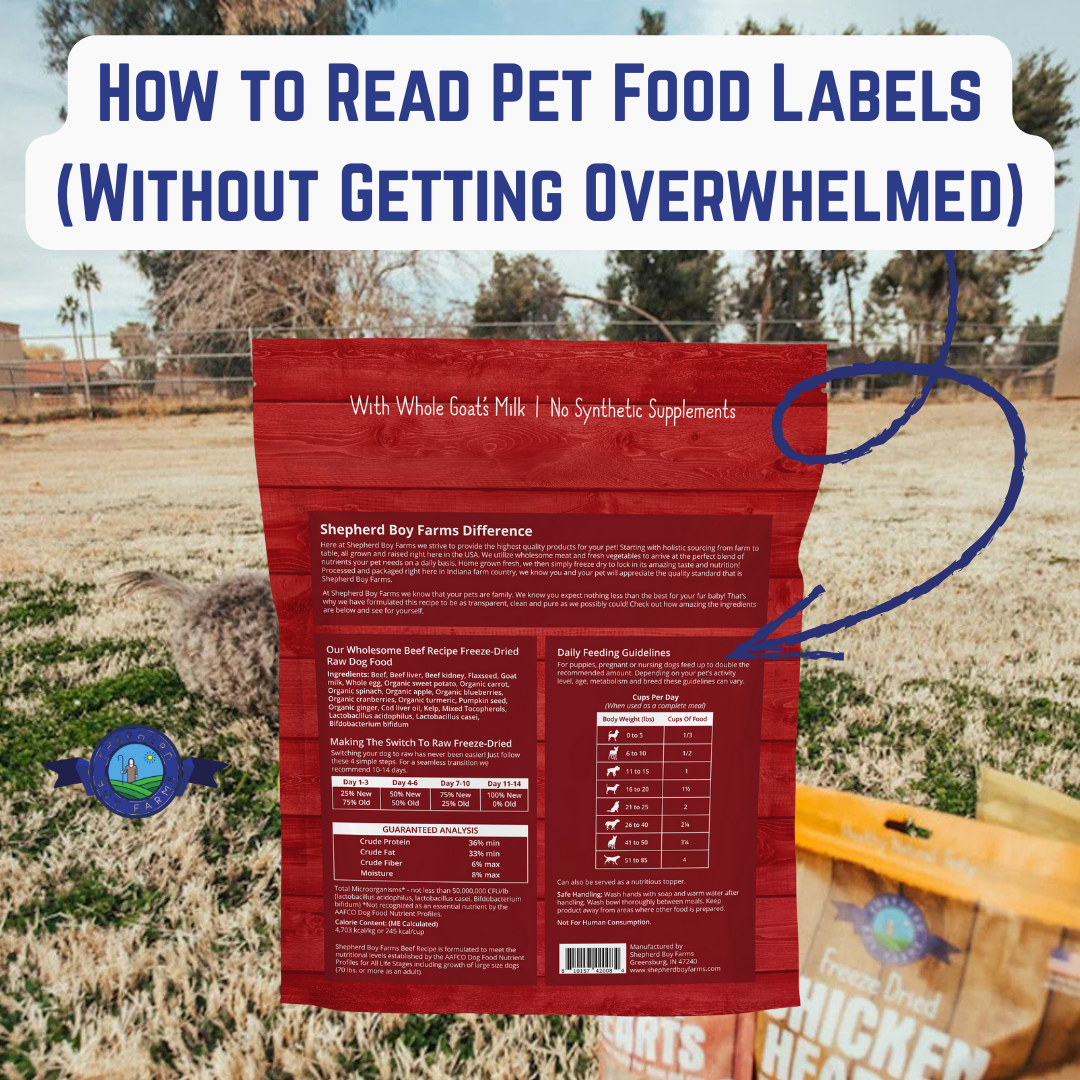
Choosing your dog’s food is one of the most important decisions you make for their long-term health. But pet food labels can feel confusing, technical, or even misleading.
This guide breaks down what actually matters on a pet food label, in plain English so you can feel confident choosing the best food for your dog and cat.
Step 1: Look for Transparency
The very first thing I look for is a clear ingredient list—not just pretty pictures or marketing claims.
If I can’t easily find a full list of ingredients on the package or the company’s website, I move on. Without that information, there’s no real way to evaluate the food.
Pretty pictures of ingredients are not the same as an ingredient list and may be shown in any order.
Step 2: Understand Ingredient Order (and Why It Can Be Misleading)
Ingredients are listed from highest to lowest by weight.
Fresh meat contains about 70% water, so it’s normal and expected to see meat listed first. That’s a good thing.
However, if fresh meat is followed by a dry grain or legume (such as rice, peas, or lentils), the label alone doesn’t always tell the full story. Dry ingredients expand significantly once hydrated, which can mean the food contains more carbohydrates than it appears at first glance.
Dogs can benefit from some plant-based nutrients but generally do best on lower-carbohydrate diets. Cats, as obligate carnivores, require diets that are primarily animal-based.
Step 3: Ingredient Quality Matters
Higher-quality foods typically include:
- Real meat and organ meats
- Whole, recognizable ingredients
- Organic fruits and vegetables when possible
Humanely raised or antibiotic-free sourcing is a bonus, though availability can vary. The more information a company shares, the better equipped you are to make an informed decision.
Step 4: Don’t Ignore the Vitamin & Mineral List
At the end of the ingredient list, you’ll find added vitamins and minerals.
A short list usually suggests nutrients are coming from whole foods.
A very long list often indicates lower-quality ingredients that required heavy fortification to meet minimum nutritional standards.
Even high-quality foods may need a small number of added nutrients to meet AAFCO guidelines—but excessively long lists are a red flag.
Step 5: Use the Guaranteed Analysis to Compare Foods
The guaranteed analysis panel helps you understand how much protein, fat, and carbohydrates are actually in the food.
Because foods contain different amounts of moisture, nutrition professionals compare foods using a dry matter basis. This simply removes water from the equation so foods can be compared fairly.
Let’s compare the information on 2 different foods. The first is Nom Nom’s gently cooked beef for dogs.
Guaranteed Analysis: Gently cooked whole food beef recipe
- Crude Protein — 8% (min)
- Crude Fat — 5% (min)
- Crude Fiber — 4% (max)
- Total Carb — 8% (max)
- Moisture — 77% (max)
Because this Gently Cooked food contains a lot of moisture, the nutrients are diluted by water. When converted to a dry matter basis the nutrition looks like this:
- Protein: 34.8%
- Fat: 21.7%
- Carbohydrates: 34.8%
What this means:
Once water is removed, this recipe provides moderate protein but a relatively high amount of carbohydrates for a dog.
On the other hand, let’s look at Shepherd Boy Farm’s freeze-dried beef recipe:
Shepherd Boy Farms Freeze-Dried Beef Recipe
Guaranteed Analysis: Shepherd Boy Farms freeze-dried beef recipe
- Crude Protein — 38% (min)
- Crude Fat — 36% (min)
- Crude Fiber — 6% (max)
- Moisture — 8% (max)
Freeze-dried food contains very little moisture, so nutrients are much more concentrated. On a dry matter basis, this recipe provides:
- Protein: 41.3%
- Fat: 34.7%
- Carbohydrates: approximately 16%
What this means:
Shepherd Boy Farms provides higher protein and significantly lower carbohydrates, making it more aligned with a dog’s biological needs.
Note: Carbohydrates are calculated when not listed by accounting for protein, fat, moisture, and minerals.
Step 6: Always Check the AAFCO Feeding Statement
The Association of American Feed Control Officials (AAFCO) feeding statement is usually in small print on the back of the package, but it’s critical.
- “Intended for intermittent or supplemental feeding” This means the food is not nutritionally complete and should only be used as a topper or treat.
- “Complete and balanced” This means the food provides all essential nutrients needed to prevent deficiencies.
Foods labeled for all life stages meet the nutritional requirements for puppies, pregnant or nursing dogs, and adults. These are typically the most nutrient-dense options.
The Bottom Line
When choosing a food for your dog, look for:
- Transparency and full ingredient disclosure
- Meat and organ meats as primary ingredients
- Minimal fillers and unnecessary carbohydrates
- A reasonable vitamin and mineral list
- An AAFCO statement confirming the food is complete and balanced
Once you know what to look for, pet food labels become far less intimidating and far more empowering.
Dr. Evelyn Kass, DVM, is a small animal veterinarian with over 30 years’ experience
with a passion for holistic integrative medicine and a focus on holistic nutrition. Her goal
is to teach pet owners that health begins in the gut and food can help support and
strengthen their system.


Leave a comment
This site is protected by hCaptcha and the hCaptcha Privacy Policy and Terms of Service apply.